Quick Answer
Agentic commerce means AI agents — not just humans — are starting to browse, compare, and complete purchases on behalf of shoppers. Shopify has been building toward this with tools like its Storefront APIs, checkout extensibility, and agent-friendly protocols that let AI assistants interact with stores programmatically. For developers, this changes how stores need to be structured: product data has to be machine-readable, checkout flows need to support non-human buyers, and app logic has to account for agents acting faster and differently than people. If you’re building or maintaining a Shopify store, understanding these shifts now, ideally with a Shopify Development Company India that’s already testing agentic workflows, puts you ahead of a change that’s moving faster than most teams expect.
Why This Matters Right Now
For years, ecommerce development assumed a human was on the other end of every session. Someone typed a search query, scrolled a page, added something to a cart, and clicked checkout.
That assumption is starting to break down. AI shopping agents, tools that can search, compare prices, and even complete purchases on a person’s behalf, are moving from experiments to real features inside chat assistants and browser tools. Shopify, as one of the largest ecommerce platforms, is a natural testing ground for this shift.
For developers, this isn’t a future problem to think about later. Store architecture, API design, and checkout logic built today will determine whether a store works well with these agents or gets left behind. This article breaks down what agentic commerce actually means, what Shopify has built so far, and what developers should be doing about it right now. Elite Webbies has been tracking these changes closely as part of our Shopify development work, and this is a practical look at where things stand.
What Is Agentic Commerce, Exactly?
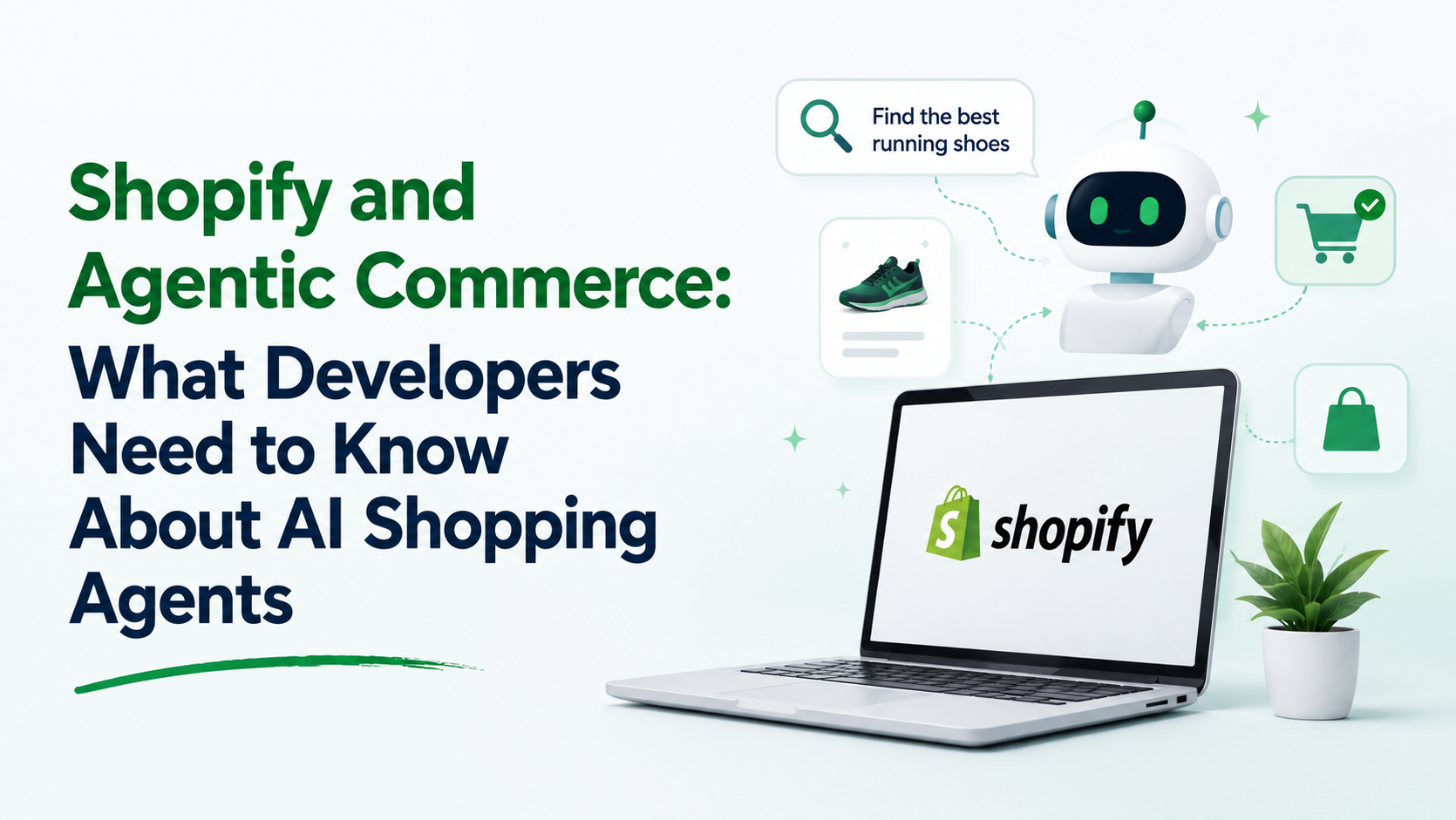
Agentic commerce refers to AI systems acting as buyers, or as assistants to buyers, completing steps in the shopping process without constant human input.
This can look like:
- – A shopping assistant comparing prices across several stores and recommending the best option
- – An AI agent completing a repeat purchase automatically based on past behavior
- – A chatbot inside a messaging app that searches a store’s catalog and checks out for the user
- – A browser-based agent that fills out shipping and payment details on a store’s behalf
The important distinction is between AI helping a human shop (like a recommendation widget) and AI acting on a human’s behalf through actual transactions. Agentic commerce is specifically about the second kind.
How Shopify Is Positioning Itself for Agentic Commerce
Shopify has been adding infrastructure that supports this shift, even where it isn’t labeled explicitly as “agentic.”
Storefront API and Headless Architecture
Shopify’s Storefront API already lets developers build custom front ends that pull product data, pricing, and inventory through GraphQL queries. This same API layer is what allows external AI agents to query store data programmatically, rather than needing to parse a rendered webpage.
Checkout Extensibility
Shopify’s checkout extensibility framework allows developers to customize checkout steps through app blocks and functions. This matters for agentic commerce because an AI agent completing a purchase needs a checkout flow that can handle non-standard inputs, like a pre-filled shipping address from an agent’s stored profile.
Structured Product Data
Shopify stores that maintain clean, structured metafields and product schema markup are easier for AI agents to parse correctly. An agent trying to compare “sizes available” or “shipping time” needs that data in a consistent, machine-readable format, not buried in unstructured description text.
How Developers Should Prepare Shopify Stores for AI Agents
-
1. Clean Up Product Data Structure
AI agents rely on structured data to understand what they’re looking at. This means:
- – Using Shopify metafields consistently for size, material, dimensions, and other variant details
- – Adding proper schema.org markup for products, so agents (and search engines) can extract price, availability, and reviews accurately
- – Avoiding critical product details buried only in image text or unstructured HTML
A product page that reads clearly to a human but has messy underlying data will confuse an agent trying to parse it.
-
2. Build APIs That Agents Can Actually Use
If a store relies entirely on a rendered frontend with no clean API access, agents will struggle to interact with it reliably.
Developers should:
- – Confirm Storefront API access is properly configured and rate limits are understood
- – Document custom endpoints clearly if building headless or hybrid setups
- – Test API responses for consistency, since agents can’t “figure out” a broken response the way a human might work around a confusing page
-
3. Review Checkout Flows for Non-Human Buyers
Checkout extensibility gives developers control over custom validation, upsells, and form fields. When preparing for agentic buyers, it’s worth checking:
- – Whether custom checkout validations assume human interaction patterns (like specific timing between form fields)
- – If CAPTCHA or bot-detection tools might block legitimate AI shopping agents acting on behalf of real customers
- – Whether payment and address autofill logic works smoothly with programmatically submitted data
-
4. Plan for Agent-Specific Edge Cases
Agents don’t behave exactly like human shoppers. They might:
- – Query the same product multiple times in quick succession while comparing options
- – Submit orders faster than typical human checkout timing
- – Retry failed requests automatically, which can trigger duplicate order concerns if not handled properly
Building in proper idempotency checks (so a retried request doesn’t create a duplicate order) becomes more important in this context.
Common Mistakes Developers Make Preparing for Agentic Commerce
- – Treating it as a far-off concern. Agentic shopping tools are already live in various forms. Waiting until it’s a proven mainstream behavior means playing catch-up later.
- – Blocking bots indiscriminately. Aggressive bot-detection rules built for stopping scrapers and fraud can also block legitimate AI shopping agents. Developers need smarter detection that distinguishes malicious bots from agents acting for real customers.
- – Leaving product data messy because “customers can still read it.” Human-readable isn’t the same as machine-readable. A description that makes sense visually might still be unusable for an agent parsing structured fields.
- – Ignoring checkout performance under rapid requests. Human checkout has natural pacing. Agent-driven checkout can hit endpoints faster and more repetitively, which can expose performance issues that weren’t visible before.
- – Assuming one big overhaul is required. Most stores don’t need a full rebuild. Incremental fixes, cleaner metafields, better API documentation, and checkout testing, cover most of the groundwork.
A Practical Example: Preparing a Catalog for Agent Readability
Consider a mid-sized Shopify store selling outdoor gear with a catalog of a few thousand SKUs.
– Problem: Product variants (size, color, material) were stored inconsistently, some in metafields, some only mentioned in description text. This made the data hard for any structured system, including search engines and any AI tool, to parse reliably.
– Strategy: Standardize all variant attributes into proper Shopify metafields, add schema.org product markup across all pages, and audit the Storefront API responses for consistency.
– Implementation: Developers migrated variant data into structured metafields in batches, verified schema markup using Google’s Rich Results testing tools, and ran API response checks against a sample of product queries to confirm consistent formatting.
– Result: Product data became consistently structured across the catalog, which improved both search engine rich snippet eligibility and the reliability of any system, human-built or AI-driven, querying that data.
– Key lesson: Preparing for agentic commerce often overlaps directly with good data hygiene and SEO practices already worth doing. It’s not a separate project bolted on top.
Best Practices for Shopify Developers Right Now
- – Keep product data structured in metafields rather than relying on description text for critical details
- – Test checkout extensibility customizations against both human and automated submission patterns
- – Document Storefront API and any custom endpoints clearly for internal and external use
- – Review bot-detection and rate-limiting rules to avoid blocking legitimate shopping agents
- – Build idempotency into order creation logic to handle retried or duplicate agent requests safely
- – Stay current with Shopify’s developer changelog, since agentic commerce features are still evolving
Tools and Resources Worth Knowing
- – Shopify Storefront API documentation — the core reference for building headless or agent-accessible storefronts
- – Shopify Checkout Extensibility docs — for customizing checkout steps without breaking compatibility with future updates
- – Schema.org Product markup guidelines — for making product data machine-readable
- – Google’s Rich Results Test tool — for verifying structured data is being read correctly
These aren’t agentic-commerce-specific tools by name, but they’re the foundation that makes a store ready for AI agents and search engines alike.
Why Work With an Experienced Shopify Development Partner
Agentic commerce is still a moving target, and most teams don’t have the bandwidth to track every platform update while also running day-to-day development work.
A Shopify Development Company India with hands-on experience in Storefront API integrations, checkout extensibility, and structured data can help audit a store’s current readiness without requiring a full rebuild. If you’re looking to Hire Shopify Developer India for this kind of forward-looking audit, ask specifically about their experience with headless Shopify builds and structured product data, not just general storefront design.
Elite Webbies works with store owners on exactly this kind of technical groundwork, cleaning up data structures, testing API reliability, and reviewing checkout flows so stores stay compatible as agentic shopping tools become more common. As an Ecommerce Development Company India, our focus stays on practical, testable changes rather than speculative rebuilds chasing every new trend.
Frequently Asked Questions
1. What is agentic commerce in simple terms?
Answer: Agentic commerce is when AI agents, not humans directly, search for products, compare options, and complete purchases on a shopper’s behalf. It shifts part of the buying process from manual clicks to automated, AI-driven actions.
2. Does my Shopify store need special features to support AI shopping agents?
Answer: Not entirely new features, but proper preparation. Clean structured product data, reliable API access, and checkout flows that handle non-human input smoothly all matter more as agentic shopping tools become common.
3. Will AI shopping agents replace human customers on Shopify stores?
Answer: No. Agents typically act on behalf of real customers rather than replacing them entirely. The shopper still exists; the agent handles some of the searching, comparing, or transaction steps for them.
4.How does checkout extensibility relate to agentic commerce?
Answer: Checkout extensibility lets developers customize checkout steps through Shopify’s app framework. Building these customizations to handle programmatic, agent-submitted data properly avoids blocking legitimate automated purchases.
5. Should I hire a Shopify developer in India for this kind of work?
Answer: If you’re looking to prepare your store for AI-driven shopping trends, working with a Shopify Development Company India experienced in Storefront APIs and structured data can be a practical, cost-effective way to get this groundwork done properly.
6. What’s the biggest risk of ignoring agentic commerce right now?
Answer: The main risk isn’t losing sales overnight. It’s accumulating messy product data and rigid checkout logic that becomes harder to fix later, once agentic shopping tools are handling a larger share of transactions.
7. Does structured product data help with anything besides AI agents?
Answer: Yes. Clean metafields and schema markup also improve search engine rich results, site search accuracy, and general data consistency across your catalog, benefits that exist regardless of agentic commerce trends.
8. How do I test if my Shopify store is ready for AI shopping agents?
Answer: Start by checking Storefront API response consistency, verifying schema markup with Google’s Rich Results Test, and reviewing whether bot-detection rules might block legitimate automated requests during checkout.